


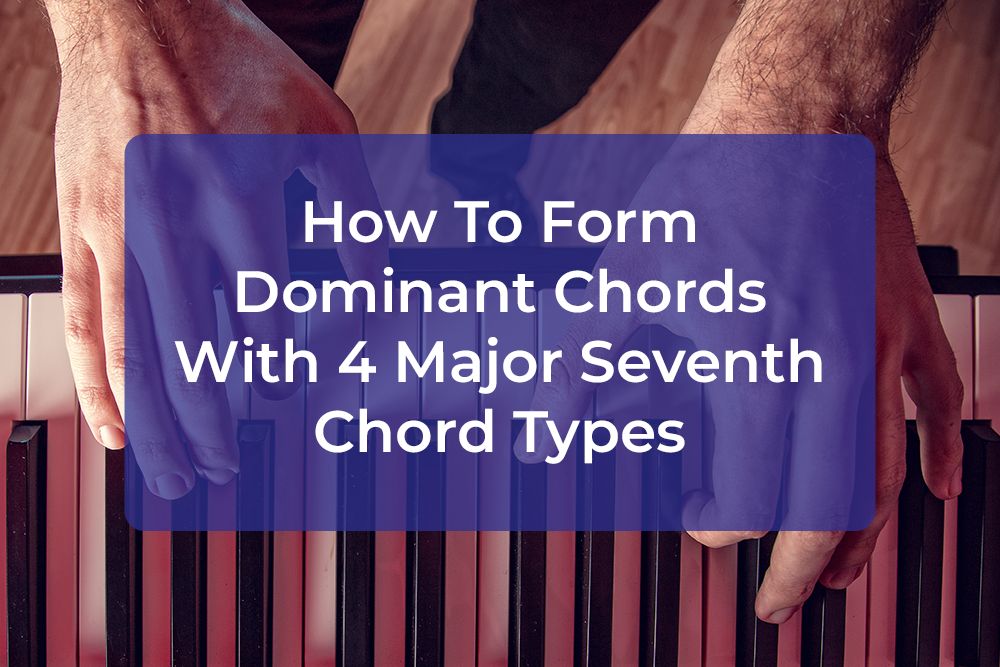
If you’re interested in learning how to form dominant chords then this lesson is for you.
The importance of dominant chords in chord progressions cannot be over-emphasized; especially in jazz and gospel music where most of the passing chords are dominant chords.
So, we’re going to explore how to form dominant chords using four different major seventh chord types.
“Here Are The Four Major Seventh Chord Types”
There are four major seventh chord types we’ll be using in the formation of dominant chords and they are as follows:
The major seventh chord
The augmented major seventh chord
The diminished major seventh chord
The major seventh [flat five] chord
Let’s have a short review on each of these seventh chord types.
The Major Seventh Chord
The major seventh chord is the 1-chord in the major key. Playing the first, third, fifth, and seventh tones of the major scale in any key produces the major seventh chord.
Using the C major scale:
…the major seventh chord can be played as the “C-E-G-B”:
…which basically consists of the first, third, fifth, and seventh tones of the C major scale.
The Augmented Major Seventh Chord
Raising the fifth tone of the major seventh chord produces the augmented major seventh chord. In the case of the C major seventh chord:
Raising its fifth tone (which is G):
…by a half-step (to G#):
…produces the C augmented major seventh chord:
The Diminished Major Seventh Chord
The diminished major seventh chord can be broken down into the diminished triad and the seventh tone of the major scale in any key you’re in.
Using the C diminished triad:
…and the seventh tone of the C major scale (which is B):
…you can form the C diminished major seventh chord:
The Major Seventh [Flat Five] Chord
Lowering the fifth tone of the major seventh chord produces the major seventh [flat five] chord. In the case of the C major seventh chord:
Lowering its fifth tone (which is G):
…by a half-step (to Gb):
…produces the C major seventh [flat five] chord:
How To Form Dominant Chords With Major Seventh Chord Types
Let’s look at how dominant chords can be formed with the major seventh chord types we covered in the previous segment.
There’s a general procedure for the formation of dominant chords with these major seventh chord types. Check it out:
Using any of the major seventh chord types we’ve covered in this lesson, you can for a dominant chord using this formula: “b7 chord/1 bass”
The “b7 chord/1 bass” formula can be used in the formation of dominant chords and I’ll be showing you step-by-step how this works.
Step 1. Choose a root note for the chord
Step 2. Go to the b7 of the root note chosen in step 1
Step 3. Then form a major seventh chord on the b7 tone
Let’s put these three steps together and don’t forget to keep the steps in mind.
Chord #1 – Using The Major Seventh Chord
In the first step, we’re basically concerned with the bass note. So, we can choose E:
…as the bass note.
Then in step 2, we’re determining the b7 of the note chosen in step 1. So, what’s the b7 of E?
The answer is D:
In the final step, we’ll be forming a major seventh chord on the b7 tone (and that’s the D major seventh chord):
Altogether, playing the D major seventh chord over E in the bass:
D major seventh chord:
E bass note:
…produces the E dominant thirteenth [suspended fourth] chord:
Chord #2 – Using The Augmented Major Seventh Chord
Using the three steps, we can also form a dominant chord using the augmented major seventh chord.
“Here’s How It Works…”
In the first step, we’re choosing the root of the dominant chord (let’s say Eb):
Then we proceed to the second step where the b7 tone in the key of the note chosen in the first step (which is Eb). The b7 in the key of Eb major:
…is Db:
After the b7 (which is Db) is determined, the third step is to form an augmented major seventh chord on Db and that’s the Db augmented major seventh chord:
If you put the bass note and the b7 augmented major seventh chord together:
Db augmented major seventh chord:
Eb bass note:
…you’ll have the Eb dominant thirteenth [sharp eleven] chord:
Chord #3 – Using The Diminished Major Seventh Chord
The first step is always concerned with the bass note. Let’s use F#:
…as the bass note. Consequently, we’ll be producing an F# dominant chord.
In step 2, we’re determining the b7 of the note chosen in step 1. So, what’s the b7 of F#?
The answer is E:
In the final step, we’ll be forming a diminished major seventh chord on the b7 tone (and that’s the E diminished major seventh chord):
Altogether, playing the E diminished major seventh chord over F# in the bass:
E diminished major seventh chord:
F# bass note:
…produces the E dominant thirteenth [flat ninth] chord:
Final Words
Using the general procedure and the four major seventh chord types covered in this lesson, anyone can form the following passing chords:
Dom13 [sus4] chord
Dom13 [#11] chord
Dom13 [b9] chord
Dom13 [add9] chord
…and they are all dominant chords.
Feel free to post your comments, questions, and suggestions in the comment section.
See you in the next lesson.


Chuku Onyemachi
Latest posts by Chuku Onyemachi (see all)
- CHORD UPGRADE: How To INSTANTLY Upgrade Triads And Seventh Chords To Ninth Chords
- The Formation Of Diminished Seventh Chords Used To Be Challenging Until I Did This
- How To Form Seventh Chords In Two Shakes Of A Dog’s Tail Using Third Intervals And The Circle Of Fifths Chart
- I Played The 13sus4 Chord And This Happened…
- How To Build Seventh Chords Like An Architect Using “Foundation And Structure” Concept




Comments on this entry are closed.