


In this lesson we’ll be clearing off the misconception of the relative minor key.
If you’ve been around musicians for a long while, you must have come across the concept of the relative minor key; especially the common misconception out there.
A good way to start this lesson is with an explanation of the concept of the relative minor key.
“What Is A Relative Minor Key?”
There are 24 keys in tonal music:
12 major keys
12 minor keys
Every major key has its parallel minor key. For example, the key of C major:
…has the key of C minor:
…as its parallel minor key.
The Concept Of Relative Keys
Beyond the parallel relationship between major and minor keys, there’s also a relative relationship between major and minor keys.
“Here’s How It Works…”
The key of C major:
…and the key of A minor:
…are said to be relative keys because they have the same key-signature (sharing exactly the same notes).
The notes in the key of C major:
…and A minor:
…are basically the same notes. From C to C:
…produces the key of C major:
…while from A to A:
…produces the key of A minor:
“So, What Are Relative Keys?”
Relative keys share the same notes in common. Unlike parallel keys where the notes differ.
“Check Out These Two Parallel Keys…”
The key of C major:
…is parallel to the key of C minor:
…and they don’t have the same notes.
“Now, Carefully Check These Relative Keys Out…”
The key of C major:
…has the key of A minor:
…as its relative minor key.
How To Determine The Relative Minor Key Of Any Given Major Key
The relative minor key of any given major key can be determined by going down by a minor third or three half-steps from the first tone of the given major key.
For example, the relative minor of the key of Bb major:
…can be determined by going down three half-steps from Bb:
Bb to A:
…the first half-step.A to Ab:
…the second half-step.Ab to G:
…the third half-step.
So, the relative minor key to the key of Bb major:
…is the key of G minor:
A closer look at both keys shows that they are basically consist of the same notes. However, while the key of Bb major:
…is from Bb to Bb:
…the key of G minor:
…has exactly the same notes from G to G:
Here’s the music clock:
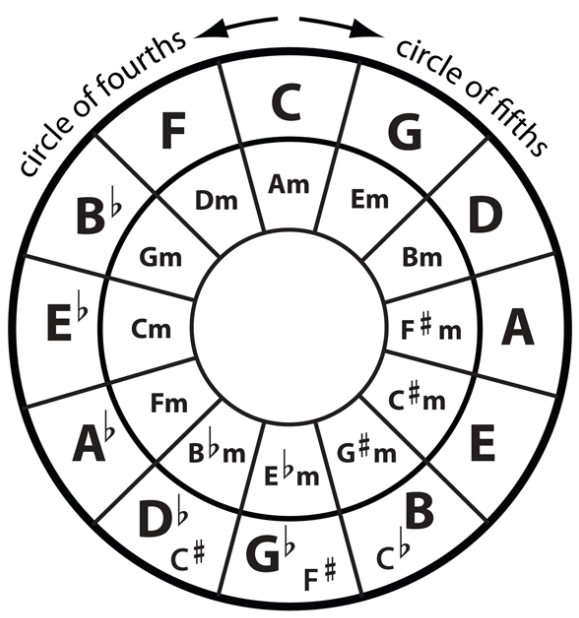
…which is a geometrical representation of the major keys and their relative minor keys.
The Common Misconception Of The Relative Minor Key
There’s a common mistake a vast majority of musicians make and I’ll be showing you that misconception of the relative minor key shortly.
But before I do so, remember this:
The relative minor key is ALWAYS three half-steps below any given major key
“Alright…Here’s The Misconception”
Instead of going down by three half-steps from any given major key, a lot of musicians actually go up by three half-steps to another major key.
For example, when they’re in the key of C major:
…they understand the relative minor key as the major key that is three half-steps above C:
Three half-steps above C is Eb:
C to Db:
…is the first half-step.Db to D:
…is the second half-step.D to Eb:
…is the third half-step.
A vast majority of musicians consider the key of Eb major:
…as the relative minor key to the key of C major:
….AND THIS IS TOTALLY WRONG!
Final Words
The relative minor key to the key of C major:
…is always the key of A minor:
…and must always be a minor key.
Going up by three half-steps to another key takes us into a related key and not a relative key. In a subsequent lesson, we’ll learn what related keys are and also distinguish them from relative keys.
See you then.


Chuku Onyemachi
Latest posts by Chuku Onyemachi (see all)
- CHORD UPGRADE: How To INSTANTLY Upgrade Triads And Seventh Chords To Ninth Chords
- The Formation Of Diminished Seventh Chords Used To Be Challenging Until I Did This
- How To Form Seventh Chords In Two Shakes Of A Dog’s Tail Using Third Intervals And The Circle Of Fifths Chart
- I Played The 13sus4 Chord And This Happened…
- How To Build Seventh Chords Like An Architect Using “Foundation And Structure” Concept






Comments on this entry are closed.