


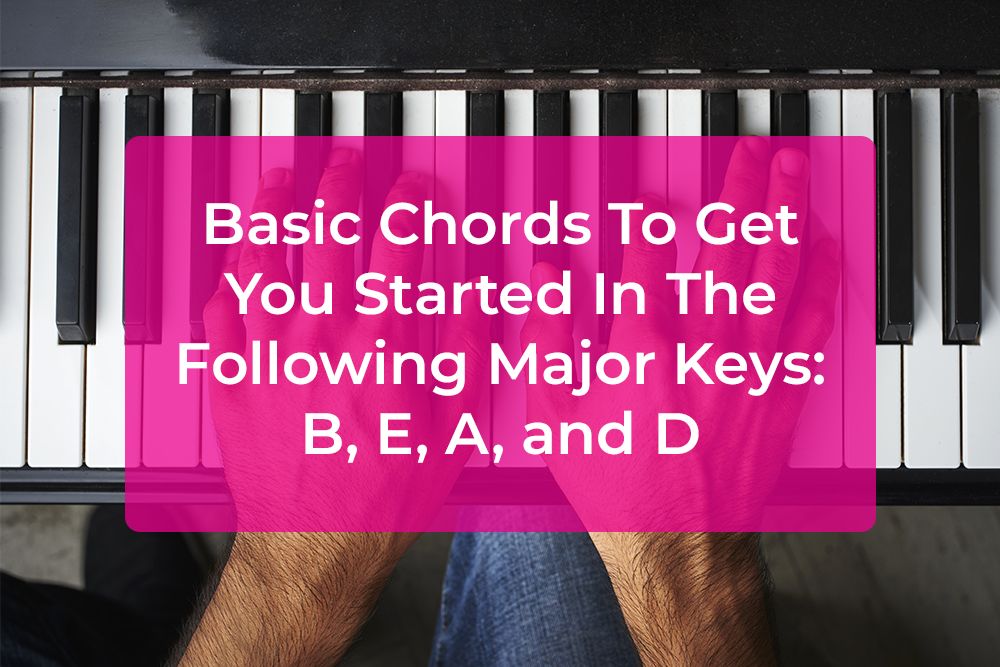
If you’re interested in basic chords that you can play in the key of B, E, A, and D major, this lesson is for you.
Depending on the part of the world where you live in, you most likely started out on the keyboard in the key of C major:
…or F major:
There are still parts of the world where people get started on black keys like Db major:
…Ab major:
…etc.
But this lesson is written for people who are yet to explore the following keys:
B major
E major
A major
D major
…and if you belong to this league of musicians I’m talking about, then you’ll be benefiting a lot from this lesson.
The Relationship Between The Key Of B, E, A, and D
There are 12 major keys on the keyboard and each key is unique because of the number of sharp notes (notes that are raised) and flat notes (notes that are lowered).
The key of F major:
…is unique because of the number of flat (one flat on B [which is Bb]) notes and there is no other key on the keyboard that has one flat note (Bb):
The use of the number of sharp and flat notes in a key to distinguish it from other keys is known as key signature and key signature is the relationship between the key of B, E, A, and D.
“Here’s What You have To Know…”
The number of sharp notes in the key of B major:
…is 5 (F#, C#, G#, D#, and A#), followed by the key of E major:
…with four sharp notes (F#, C#, G#, and D#), then the key of A major:
…with three sharp notes (F#, C#, and G#), and lastly, the key of D major:
…with two sharp notes (F# and C#).
“Take A Closer Look…”
B major (F#, C#, G#, D#, A#)
E major (F#, C#, G#, and D#)
A major (F#, C#, and G#)
D major (F# and C#)
Using the relationship between the keys in terms of key signature, learning them will not be as difficult as you think they will be.
For example, considering the number of sharp notes in the key of B major and that of the key of E major, you can clearly see that all the sharp notes in E major (which are F#, C#, G#, and D#) are in the key of B major (the key of B major only differs with the addition of an extra sharp note (F#).
So, the major keys below:
B major
E major
A major
D major
…are related by key signature.
Basic Chords In The Key Of B, E, A, and D
Now that we’ve covered the concept of key signature which explains the relationship between the key of B, E, A, and D major, let’s go ahead and learn basic chords (triads) that can get us started in these keys.
Basic Chords In The Key Of B Major
In the key of B major:
…here are the primary chords you have to be focused with:
The B major triad (the 1-chord)
The E major triad (the 4-chord)
The F# major triad (the 5-chord)
Here’s the 1-chord:
…the 4-chord:
…and the 5-chord:
In addition to the primary chords, there are secondary chords too:
The C# minor triad (the 2 chord)
The D# minor triad (the 3 chord)
The G# minor triad (the 6 chord)
Here’s the 2-chord:
…the 3-chord:
…and the 6-chord:
Using these chords in the key of B major, you should be able to get started with songs and as you practice, you’ll get more comfortable with the key.
Basic Chords In The Key Of E Major
The primary chords in the key of E major:
…are as follows:
The E major triad (the 1-chord)
The A major triad (the 4-chord)
The B major triad (the 5-chord)
Here’s the 1-chord:
…the 4-chord:
…and the 5-chord:
In addition to the primary chords, there are secondary chords too:
The F# minor triad (the 2 chord)
The G# minor triad (the 3 chord)
The C# minor triad (the 6 chord)
Here’s the 2-chord:
…the 3-chord:
…and the 6-chord:
Using these chords in the key of E major, you should be able to get started with songs and I guarantee that as you add these chords to your daily practice routine, you’ll master them in the shortest time possible.
Basic Chords In The Key Of A Major
In the key of A major:
…here are the primary chords you have to be focused with:
The A major triad (the 1-chord)
The D major triad (the 4-chord)
The E major triad (the 5-chord)
Here’s the 1-chord:
…the 4-chord:
…and the 5-chord:
In addition to the primary chords, there are secondary chords too:
The B minor triad (the 2 chord)
The C# minor triad (the 3 chord)
The F# minor triad (the 6 chord)
Here’s the 2-chord:
…the 3-chord:
…and the 6-chord:
Using these chords in the key of A major, you should be able to get started with songs and as you practice, you’ll get more comfortable with the key.
Basic Chords In The Key Of D Major
The primary chords in the key of D major:
…are as follows:
The D major triad (the 1-chord)
The G major triad (the 4-chord)
The A major triad (the 5-chord)
Here’s the 1-chord:
…the 4-chord:
…and the 5-chord:
In addition to the primary chords, there are secondary chords too:
The E minor triad (the 2 chord)
The F# minor triad (the 3 chord)
The B minor triad (the 6 chord)
Here’s the 2-chord:
…the 3-chord:
…and the 6-chord:
Using these chords in the key of E major, you should be able to get started with songs and I guarantee that as you add these chords to your daily practice routine, you’ll master them in the shortest time possible.
Final Words
Using the chords learned in this blog, I’m doubly sure that you can play songs in any of the keys covered.
“But That’s Not All…”
You need to practice the major scale in all these keys and also learn the major and minor triads associated with every tone of the scale.
We’ll cover all these and more in a subsequent lesson.
Keep up the great work!


Chuku Onyemachi
Latest posts by Chuku Onyemachi (see all)
- CHORD UPGRADE: How To INSTANTLY Upgrade Triads And Seventh Chords To Ninth Chords
- The Formation Of Diminished Seventh Chords Used To Be Challenging Until I Did This
- How To Form Seventh Chords In Two Shakes Of A Dog’s Tail Using Third Intervals And The Circle Of Fifths Chart
- I Played The 13sus4 Chord And This Happened…
- How To Build Seventh Chords Like An Architect Using “Foundation And Structure” Concept



Comments on this entry are closed.