Tip #1: Understand how music works
One of the biggest myths is that you don’t have to understand music to play by ear. You just play. That is the furthest from the truth.
While there are a lot of “gifted” and talented musicians out there that have no idea what they are playing (…they just play by listening), this is not the way you want to be. At least if you can help it.
Believe it or not, understanding how scales are formed and how they create chords and progressions is one of the most important things you can learn.
(By the way, major scales are a series of seven unique notes played one after the other. They are the basis of what we call “major keys” and everything is based on them. Chords are three or more notes played at the same time. These are the combined sounds you hear in songs. Chord progressions are no more than chords going from one to the other… a series of chords played one after the other).
As you’ll learn in “The Secrets to Playing Piano by Ear,” scales basically create chords. Chords create progressions -and- progressions ultimately create the songs you hear! Understanding “how” and “why” is the difference between an average musician and a professional musician.
Tip #2: Master the patterns rather than memorizing stuff
I always get asked, “How do you memorize thousands of songs?”
The answer is I don’t. I understand patterns.
A couple dozen songs may follow the same exact patterns — so to a regular person, they think I know 36 songs but all I’m doing is playing the same pattern. Yes, the song may be in a different key (there are 12 keys but once you understand scales and patterns, you can instantly play ONE song in all TWELVE keys very easily). The song may have a different melody, but at the end of the day, it will almost always share the same chords and patterns as many other songs.
Tip #3: Learn to listen
Playing by ear is not reserved for geniuses. It’s all about listening.
Do you hear tones going up? or down? Does a chord sound happy (perhaps its a major chord) or sad and serious (minor chord). Maybe it’s a scary chord… spooky (diminished chord). How about a blues chord… very soulful-like (dominant chord).
See… all these chords have feelings attached to them. Those that play seamlessly what they hear and feel have simply learned how to unlock their ears. In “The Secrets to Playing Piano By Ear,” there are many ways to build your listening skills.
Tip #4: Become a pro at recognizing intervals
“Intervals,” in music, are distances between notes. As easy as that.
There are very small intervals out there like unison, seconds, and thirds and there are larger ones like fifths, sixths, and sevenths. These intervals actually help to name the chords that we play. When you say the name “major chord,” you’re actually referring to a particular interval in that chord that gives the chord its main sound quality. The same applies to minor and other chords.
There are different kinds of intervals: melodic and harmonic.
Melodic intervals are distances between single notes, played one after the other. Like “melodies.”
Harmonic intervals are distances between notes played at the same time (i.e. – “chords”).
Songs contain both melody and harmony (chords) so becoming a pro at recognizing these allows you to hear the stuff songs are made of! And if you can do that, then it’s just a matter of putting this interval with that interval and you get chords and progressions. More on this later.
Tip #5: Practice and get some real-world experience
You can study, study, study all you want but it won’t do you any good if you don’t put what you learn into action. Of course, this sounds a little cliché but it’s the truth.
Practice doesn’t make perfect.
Perfect practice makes perfect. Make sure to practice the right stuff. I’ve learned in music (and practically in life) that:
1) You can do things right
2) You can do the right things
There’s a difference. You can do things right… the WRONG things right. Focus on the right things and do THEM right and you’ll get better fast. “The Secrets to Playing Piano by Ear” gives you a lot of things to practice (scales, modes, chords, progressions, harmonization techniques, etc.).
In the area of speed and finger independence, Hanon are great exercises. Focus on the right things and do them as best as you can, and you can’t go wrong.
Well, that’s it for today.
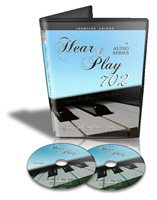
Hear and Play 702: Piano By Ear For Starters
The Hear and Play 702 Audio Series is a 2-hour, 2-disc set that specializes in taking you from the VERY beginning all the way to playing basic songs (popular ones at that). You’ll study everything from the notes on the piano, scales, and basic chords to melody, harmonization, and even progressions!
If you’re a newbie and want to be up and playing in less than a few days, you can’t afford to miss this opportunity at this incredible price. Click here to learn more | Buy now
I’ll back tomorrow!