Yesterday, we talked about the primary chords of a scale.
We established that the 1, 4 and 5 are the most important degrees of any scale and that you can pretty much play tons of songs with these chords.
In fact, you can play most songs with just these chords.
(Your songs may sound basic but the point is that you can do it!)
But now, I want to take it a step further and show you how to get those other tones of the scale working for you.
Let’s turn back to the C major scale…
C major
C D E F G A B C
1 2 3 4 5 6 7
(Of course, we’ve numbered our scale because this is of no use if we don’t think universally… and numbers allow us to apply this to any key later on so get used to thinking in terms of numbers).
As you know, the primary chords are on the 1st, 4th, and 5th degrees:
C F G
1 4 5
But now, let’s take it a step further.
Music loves to move in fourths and fifths.
In fact, the interval between “C” and “F” is a fourth (“perfect fourth,” specifically).
And the interval between “C” and “G” is a fifth.
To find out what interval you’re working with, count the number of alphabet letters encompassed in the interval (that includes the starting and ending notes).
So, between C and F, there is C – D – E – F. Four alphabet letters means this is a fourth interval.
Note: Don’t mix up alphabet letters and notes. When you count white and black keys, there are much more than four notes in this interval. That’s not what we’re talking about. We’re solely talking about alphabet letters and not even concerned with anything else.
How many alphabet letters are in between C and G?
Well, let’s see…
C – D – E – F – G
Five! That’s why this is a fifth interval. Get it?
For this lesson, we’re only going to focus on fourths as they are much more common than fifths in popular chord progressions.
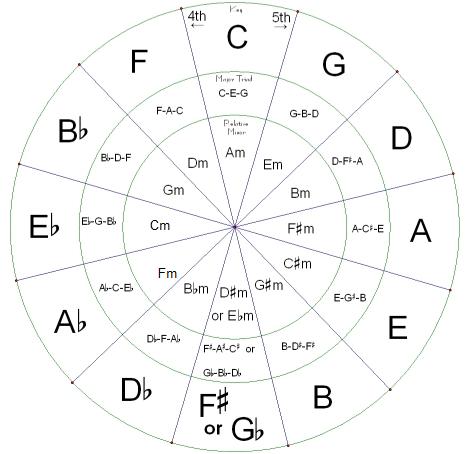
See this circle?
We’re going to focus on going counter-clockwise. That is, the direction from C to F to Bb and so on.
These are fourths. Plain and simple.
If you write them out, it’ll look like this:
Memorize this! This is the direction most songs flow in.
And this is what I want to use to help you add flavor to your primary chords.
Question…
What are the primary chords of C?
(This is easy. You already know the answer because it’s at the top of this page).
Another question…
Where do these primary chords lie on the circle?
Bingo! They are neighbors!
C is right in the middle. To its left is F and to the right is G.
That means they have a very close relationship. This circle isn’t just a pretty way to organize keys… it’s a circle of close relationships and the closer notes are arranged on this circle, the stronger they pull and work with each other.
- Take the key you want to find primary chords for and circle it on the chart (of course, this will be the 1st primary chord).
- Then go to its left neighbor. This will be another one of the primary chords (4th).
- Then go to its right neighbor. That’ll be the final primary chord (5th).
Bam! The primary chords for any key.
But back to the lesson…
Remember I said that music usually flows in fourths and that going counter-clockwise around the circle will give you fourths?
Well, think about it. In yesterday’s, lesson, I told you that Gmaj has a very strong pull to Cmaj. Now, notice where G is on the circle. It’s to the right of C (as we just learned) and comes right before it, if you’re moving counter-clockwise around the circle.
And pretty much the whole circle works that way.
They key directly to the right side is what pulls the strongest to its neighbor on the left.
So G pulls strong to C.
C pulls strong to F.
F pulls strong to Bb.
Bb pulls strong to Eb.
E pulls strong to A on the other side of the circle.
D pulls strong to G.
Hmm, D pulls strong to G…
(And it works the other way around too. G pulls strong to D as well. But for this lesson, we’re focusing on fourths and the counter-clockwise direction of the circle because this is more common in chord progressions).
I’ve got an idea.
Why don’t we take a song from yesterday and see if we can pull to any of the Gmaj chords by first using some type of D chord?
But first, let’s make sure we talk about the numbers behind this…
C D E F G A B C
1 2 3 4 5 6 7C F G
1 4 5
Now, we’ve introduced “D.”
C D F G
1 2 4 5
So basically, the “2” leads strongly to the “5.” (Remember that rule).
In other words, if I’m playing a song only with primary chords and I want to start venturing outside my comfort zone, I can first try out a chord on the “2” and there is a high probability that it will work to lead to the “5.”
If the circle says it, then it’s right! 🙂
So let’s take a song from yesterday and see what happens.
“A-ma-zing grace how”
C major ~~~~~~~
(C + E + G)(Note: It sounds better to play the chord on “ma-zing” rather than on the first syllable, “A”)
“Sweet the”
F major ~~
(F + A + C)“Sound.”
C major ~
(C + E + G)“That saved a wretch like”
C major ~~~~~~~~~~~~~~~
(C + E + G)“Me”
G major
(G + B + D)
Now what we can do is slip a 2-chord before the G major.
So that means it should come on:
“wretch like”
(…your ear should have told you that if there should be a new chord added, the best place would be here).
Now, normally the 2-chord is minor. You’d have to go to past lessons to get the scoop on that because this post will be super long if I explain each tone and chord of the major scale.
So try minor there first.
See how it sounds to your ear.
“That saved a”
C major ~~~~~~~~~~~~~~~
(C + E + G)“wretch like”
D minor ~~~
(D + F + A)“Me”
G major
(G + B + D)
Now, the D minor can surely work there but if it were me, I’d keep fishing for a closer match on this 2-chord.
So let’s try D major…
“That saved a”
C major ~~~
(C + E + G)“wretch like”
D major ~~~
(D + F# + A)“Me”
G major
(G + B + D)
Sounds much better doesn’t it!?!
I know this is a beginner post but keeping the melody on top is very important.
And the melody on “wretch” is the note, “E.”
But “E” isn’t in the D major chord so there are two ways you can do this to spice up your chord movement.
1) Try to add “E” to the chord as the highest note
OR…
2) Try to rearrange chord so that you can add “E” on top.
Right now, adding E on top of “D + F# + A” is kinda hard.
But that’s where possibility #2 comes in.
What if we invert this D major chord so that D is on top? Again, I can’t really talk about inversions here or this post will be super long. Just use the search box up top to search for posts that talk about inversions and you’ll be caught up to speed!
So inverting the D major chord to “F# + A + D” (aka – “first inversion”) allows us to put an “E” right on top:
F# + A + D + E
Now, I personally don’t like the sound the “D” and “E” make up top and since I’d most likely be playing “D” on my bass (in the left hand), I’m going to take it out.
That leaves me with “F# + A + E” over “D” bass.
You wanna know what chord you’re playing here?
D major (add 9)
(F# + A + E on right hand / D on bass)
That’s not bad for a beginning lesson!
But do you see how easy it is to naturally start playing more complex chords? One thing leads to another… one requirement leads to the next and before you know it, your ear has taken you to something totally different!
In fact, you can add a C in there and make this a D dominant ninth chord (“D9” for short).
D9
(F# + A + C + E / D on bass)
The following is Amazing Grace with the added 2-chord and other inversions to keep the melody on top. Pay close attention to the order of notes in each chord as I’ve made some changes:
“A-ma-zing grace* how”
C major (1st inversion) ~~~
(E + G + C)*On “grace,” the melody changes to “E” so you can actually invert your chord from “E+G+C” to “G+C+E” (which is 2nd inversion).
“Sweet the”
F major (root inversion) ~~~
(F + A + C)“Sound.”
C major (root inversion) ~~~
(C + E + G)“That saved a”
C major (1st inversion) ~~~
(E + G + C)“wretch like”
D major (add 9) ~~~
(F# + A + E / D bass)-OR-
D9
(F# + A + C + E / D bass)“Me”
G major (first inversion) ~~~
(B + D + G)
(Unless otherwise noted, you can play these chords on your right hand and you can play the keynotes of the chords as the bass notes on your left. Basically, C major means “C on left” and “C+E+G on right.” Or you can play the chords on your left and pick out the melody and play it on your right hand. Try both ways and see what you like best.)
So there you have it! Without getting too deep (because there’s always tomorrow… and the next day… and the next day), we’ve learned how to start using other tones of the scale to lead us to our primary chords.
Until next time!