Here’s an exercise that’ll get you to remember “couples” tonight

Posted on 14 November 2008 See Comments | Post Comment


In yesterday’s lesson, I talked about couples.

The premise was basically to look at chord progressions as small little “couples.”

(When I say “couple,” I’m specifically talking about a pair of chords… just two.)

When you think in terms of “couples,” you focus on two things:

1) What chord does this current one strongly pull to?

2) What chord pulls strongly to this current one?

This understanding is based on the circle of fifths.
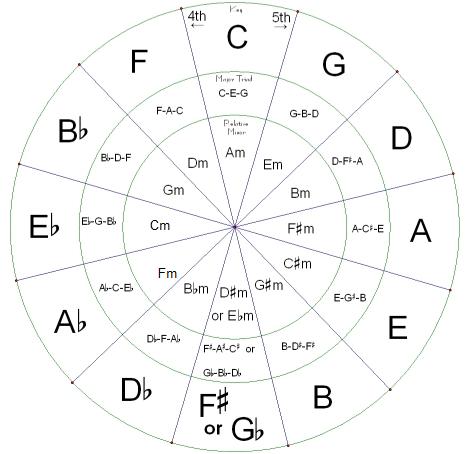
Every chord has a chord that leads strongly to it (a fourth down) —or— a chord that it strongly leads to (a fourth up).

In other words, either something is coming at it or it’s going somewhere! I hope you get that…

If you look at the circle above, focus on going counter-clockwise — that is, from C to F to Bb and so on. If this were a clock, you’d focus on going the direction of “12 o clock” to “11 o clock” to “10 o clock” and so on.

This is the direction music commonly flows in! Understand this and you understand music!

So if you look at “C,” ask yourself two questions:

1) What does C pull strongly to?

and…

2) What pulls strongly to C?

That is the idea of “coupling.” It’s my “micro” way of understanding bigger chord progression. (I actually introduced this little concept several years ago in my GospelKeys 202 course. I just thought I’d revisit it.)

Now the answer to the above questions are found right on the circle…

If you’re going counter-clockwise, then the answer to the question, “what does C lead to” is simple… “F” because that’s the next key on the circle. In fact, if you compare the major scales of C and F, you’ll notice only a single note difference. That’s right, they share all the same notes except for one. So the first answer is “F.” That is the key most C chords will lead to.

To answer the second question, just look on the other side of “C.” That is the key that most likely leads to C. So the answer is G.

Just like C has a huge tendency to lead to F — G has a strong tendency to lead to C (and if you compare their major scales, they also share all but one note).

So here’s what I’ve done. I’ve created this little exercise below. It quizzes you on all the different keys and helps you to become quicker at answering these two “magic” questions. I’ve done the first one for you. Just put your cursor in each box and type in what you think the answer is. Once you’re done, scroll down and compare your answers with mine.

(It’s much easier to press the “tab” button in between questions. This will make your cursor automatically go to the next box).

Also, try using this stopwatch tool to see how long it takes you. Post your time in the comments area!


The "What leads to" Game


What leads to G?
What leads to Db?
What leads to C?
What leads to A?
What leads to A#?
What leads to C#?
What leads to D?
What leads to B?
What leads to E?
What leads to F?
What leads to F#?
What leads to Gb?
What leads to Ab?
What leads to Bb?
What leads to Eb?
What leads to D#?
What leads to G#?
What leads to B#?
What leads to Cb?
What leads to D?
What leads to E?
 
The "What it leads to" Game


What does D lead to?
What does A lead to?
What does C lead to?
What does Bb lead to?
What does Db lead to?
What does E lead to?
What does F# lead to?
What does Ab lead to?
What does Db lead to?
What does E lead to?
What does F lead to?
What does G lead to?
What does B lead to?
What does C# lead to?
What does G# lead to?
What does E# lead to?
What does Eb lead to?
What does C lead to?
What does E lead to?
What does F lead to?
What does G lead to?

————–

I will post the answers in the comment section.

Hope this exercise helps!

Time for some rest! I’ve only had 4 hours of sleep today due to our latest launch

Until next time —


Who else wants to get these articles, lessons, and tips sent via e-mail regularly? Sign up to receive my blog updates and never miss a beat…

Enter your email address:

Delivered by FeedBurner


Subscribe in a reader


Why subscribe?

Popularity: 29% [?]

Welcome back! It looks like you're a regular! Thanks for your support and keep coming! (Getting updates yet?)

Related posts:

  1. Why the circle of fourths is so important when learning major scales
  2. How to combine chords and couples to create endless possibilities
  3. FINALLY CRACKED! How (and why) to use the circle of fifths to learn every chord in ALL 12 keys…
  4. Who else wants to discover the power of coupling?
  5. It’s a numbers game! Discover how to crack the code…
  6. Here’s a quick way to add even more spice to your songs
  7. Let’s squash this once and for all… Is it really “circle of fifths” or “circle of fourths?”


This post was written by:

Jermaine - who has written 299 posts on Hear and Play Music Learning Center.


Contact the author

13 Comments For This Post

  1. Jermaine says:

    Here are the answers. The ones in red are the “tricky” ones so if you got those wrong, don’t worry about it… they probably won’t come up much because E# is usually known as F (in 99.99% of the cases). But I still want you to understand enharmonic equivalents :-)…

    ——-

    couplesanswers.jpg

  2. Gavin says:

    Thanks Jermaine, I found that useful, although the enharmonics did trip me up! I think as you’ve said, repetition is the key… I find that excercises like this really help. Looking forward to the launch of the new training site next week, should be about 5pm here in Scotland… just in time for me coming home from work!

  3. TRUMUSIC1SOUL aka BRIAN says:

    THIS IS REALLY HELPFUL, LOOKING FORWARD TO FURTURE EXCERCISES

  4. Jermaine says:

    Thanks guys! How many did ya’ll miss?

  5. Eresmas says:

    Hey Jermaine, Nice exercise.

    I used 10.44.391 minutes.

    I got 3 wrong because of enharmonic intervals like E#, Db and F##(but they’re right in the “I just wanna play way”)

    I got everything right in the ‘what it leads to’ game.

    Thanks man.

  6. Eresmas says:

    Hey, by the way i used this formulae of counting 5 half steps from the given note to get to what it leads to or what led to it. I think it’s faster than going back to the circle of fifths every time to check. e.g Count 5 semitones from C to get to F (Don’t count the C).

  7. Jermaine says:

    @Eresmas: Good stuff!

    The only problem with counting half steps is that you are being too isolating rather than looking at the big picture. If you memorize the circle of fifths, you’ll never have to memorize it again. Then you don’t have to keep counting 5 half steps because in a real life situation, if you have to learn a song on the spot or at least play for someone, you don’t have time to count 5 half steps so this exercise is designed to get you to commit to memory these relationships. Once you do that and start analyzing songs, you will see these relationships all throughout.

    At any rate, whatever it takes to “I just wanna play.” Haha!

  8. bigbeardale says:

    This helps when at the keyboard.
    Play the chord in octaves with left hand thumb and little finger.
    Play the third with the 3rd finger.
    The index finger will play the 5th. This note roots the ( What leads to )

    To do the ( What it leads to )
    Play the chord the same way as above, but the chord you are looking for now, roots with the note between the third finger and the index finger. ( a 4th )

    Let me know if that is correct Jermaine.

    Dale

  9. Jermaine says:

    Yes dale! That works great!

    Thanks for the contribution!

  10. Nicki says:

    Thanks Jermaine…you have a way of making light bulbs go off in my head. I’m starting to see patterns like I’ve never seen before. I loved this excercise! Thanks for the tip bigbeardale…made the exercise much easier! First time round I did both in 4:40 but got 9 wrong. Second time I did both in 4:30 and got 3 wrong. Practice makes perfect. :)

  11. TRUMUSIC1SOUL aka BRIAN says:

    I MISSED 3…..THE ENHARMONICS, YET PRACTICING!!!LOL

  12. Maria Lupes says:

    This is awesome! I love this excercise. Thanks

  13. Robert says:

    Hi Jermaine: I’ve got to give it to you man you know what it takes to make sweet music.Thanks a lot you are God sent.(may he forever bless you and yours).rdmr

Leave a Comment or Reply...

10-Minute Video Tour


Featured Products

Categories

Subscribe Via E-mail

Enter your email address:


Archives

Other Ways to Subscribe


http://www.hearandplay.com/podcaster_full.jpg
Podcast Feed


Subscribe with My Yahoo!


Subscribe with NewsGator


Add to Technorati Favorites


 Subscribe with My AOL


 Subscribe with Rojo


 Subscribe with Bloglines


 Subscribe with Netvibes


 Subscribe with Google


 Subscribe with Pageflakes


 Subscribe with Plusmo


 Subscribe with Live.com


 Subscribe with Excite MIX


 Subscribe with Podcast Ready


 Add to Any Feed Reader


Subscribe with Zune Marketplace


Get Hear and Play Music Learning Center delivered by email


original feed View Feed XML

Find Us


On Youtube:

http://www.hearandplay.com/youtube.jpg


On iTunes:

http://www.hearandplay.com/itunes_logo.jpg
 

On Twitter:

http://www.hearandplay.com/twitter.jpg


On FriendFeed:

http://www.hearandplay.com/friendfeed.jpg


On Myspace:

http://www.hearandplay.com/myspace.jpg


On BlogTalkRadio:

 Listen to Jermaine Griggs on internet talk radio


On uStream.tv:

http://www.hearandplay.com/ustream.jpg


On Zimbio:

My Zimbio


On Mofuse: